British Council IELTS
Overview
The British Council currently administers around half of all IELTS exams each year (approximately 1.8 million).
We worked with them to improve conversion rates on their global IELTS booking platform, with the goal of increasing conversion from 2.7% to over 3%.
The existing booking journey spanned multiple systems and domains, creating a fragmented experience for users.
My role focused on identifying friction points through research and stakeholder insight.
I then helped define UX improvements to create a more seamless and trustworthy journey.
Role
- UX Designer
Timeline
- 6 months
Platform
- Web
The problem
Despite strong traffic, the IELTS booking journey was underperforming in terms of conversion.
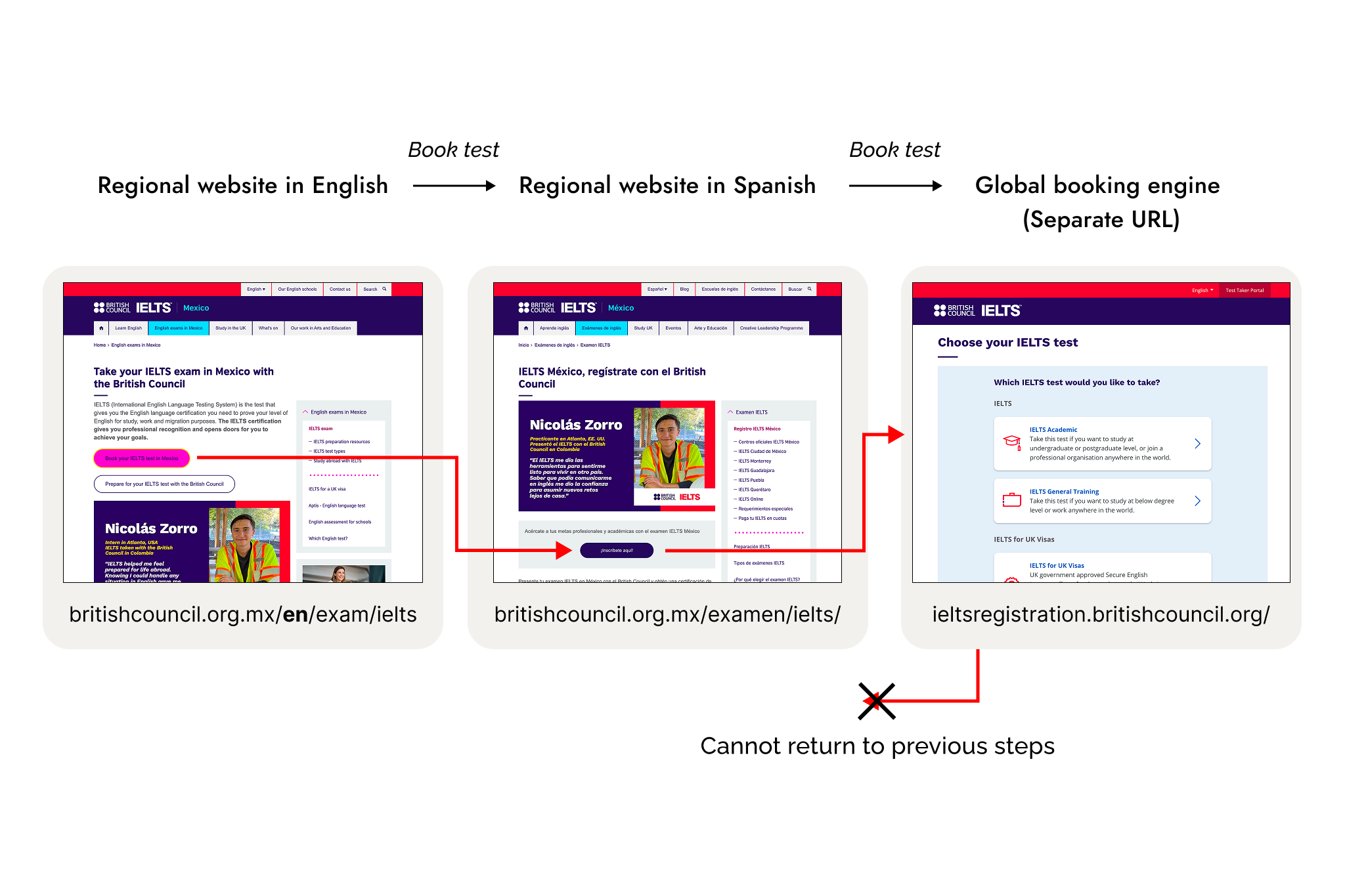
A key issue was that users were required to move between multiple domains during the booking process. Users typically started on a regional site, were redirected to a global booking portal, and then moved again to a separate payment system.
This created a fragmented experience that disrupted continuity and reduced user confidence.
This made it difficult for users to:
- Understand where they were in the process
- Build trust in the platform
- Complete their booking confidently
Scattered journey
Users were redirected across multiple domains during booking
Lack of continuity
Users couldn’t easily return to previous steps or resume progress
Confusing navigation
Transitions between systems were not clearly communicated
Drop-off risk
Each transition point introduced friction and potential abandonment
Role
I worked as part of the UX team during the discovery phase, focusing on understanding user behaviour and identifying opportunities to improve conversion.
Responsibilities
- Conducting and supporting user interviews
- Interviewing Regional Marketing Managers
- Writing interview scripts
- Mapping user journeys
- Synthesising research findings
- Producing UX recommendation decks
Constraints
There were a few key constraints that shaped the approach:
Global platform complexity
The journey spanned multiple systems and regional variations
Limited implementation ownership
The project focused on research and recommendations rather than delivery
Multiple stakeholders
Different regional teams had varying priorities and requirements
Discovery
We mapped the end-to-end booking journey to understand how users moved through the system.
The British Council’s internal teams owned different parts of the journey which added to the complexity and visual inconsistencies.
This revealed that users were required to navigate across multiple domains, with little sense of continuity between steps.
Each transition added friction and increased the likelihood of drop-off.
A typical user journey:
Regional Site
Global Booking Portal
Payment System (ORS)
The Scattered Journey
A key finding was that users struggled when attempting to pause or navigate backwards through their journey.
Because the experience spanned multiple systems:
- Progress was not always saved
- Users could not easily return to previous steps
- Navigation felt inconsistent and disjointed
This created uncertainty about where users were in the process, reducing confidence and increasing abandonment.
Identifying Drop-off Points
While analytics data was fragmented, both research and stakeholder input indicated that drop-off was particularly high at the payment stage.
We conducted extensive interviews with regional marketing managers to identify potential internal causes for this.
We found this was also compounded by:
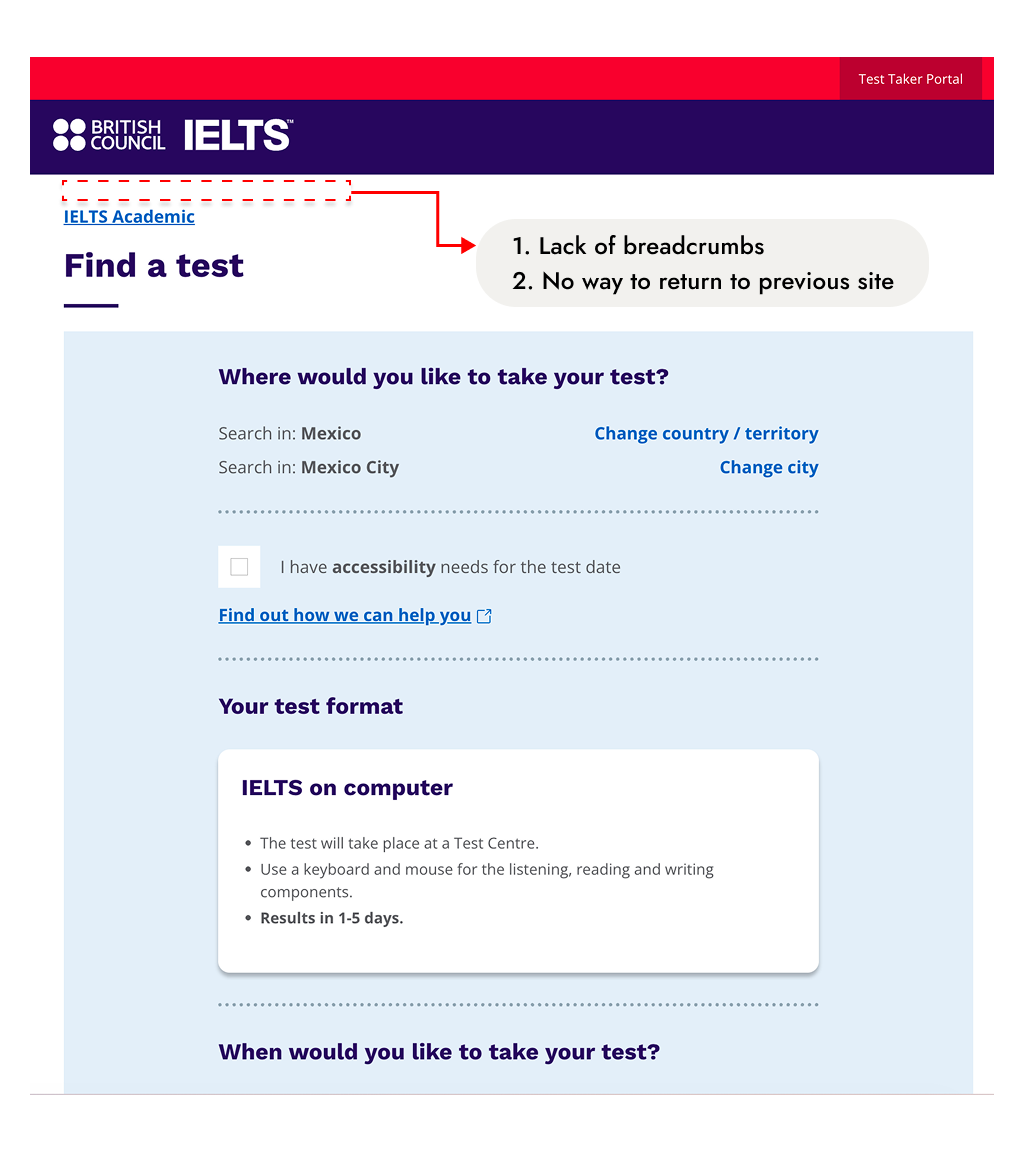
- Lack of continuity across systems (e.g. breadcrumbs, visual disparity)
- Unclear transitions
- Poor signposting when leaving the site
- Limited trust signals at key decision points
UX Recommendations
Based on our findings, we developed a set of UX recommendations focused on improving continuity and reducing friction.
Unifying the journey
We proposed moving towards a more unified domain structure to reduce fragmentation and create a more seamless experience across the booking flow.
Strengthening trust at key stages
Given the number of transitions, we recommended improving reassurance through clearer branding, messaging, and consistency across steps.
Supporting user control
To reduce frustration, users needed to be able to:
Improving clarity and guidance
Users needed greater support through:
Outcome & Impact
The project produced a set of research-driven recommendations aimed at improving conversion across the IELTS booking journey.
This work helped to:
- Identify key friction points across a complex global journey
- Highlight the impact of multi-domain experiences on user trust
- Align stakeholders around opportunities to improve conversion
- Define a clearer direction for future optimisation
Reflection & Learnings
This project strengthened my understanding of conversion-focused UX and working with large organisations and their regional teams.
It demonstrated how fragmentation between platforms can impact user trust and behaviour, particularly at critical stages such as payment.
It also reinforced the importance of aligning stakeholders and improving visibility of insights & analytics.
The next phase involved conducting a high-level digital audit of the site (of which I aided our SEO team with client playback) and addressing analytics gaps to aid in measuring project success going forward.
Next project
Read about my work with the West of England Combined Authority on their skills platform, Skills Connect.